


Fleet & Equipment Applications
What Heavy-Duty Truck Coolant Should Distributors Stock?
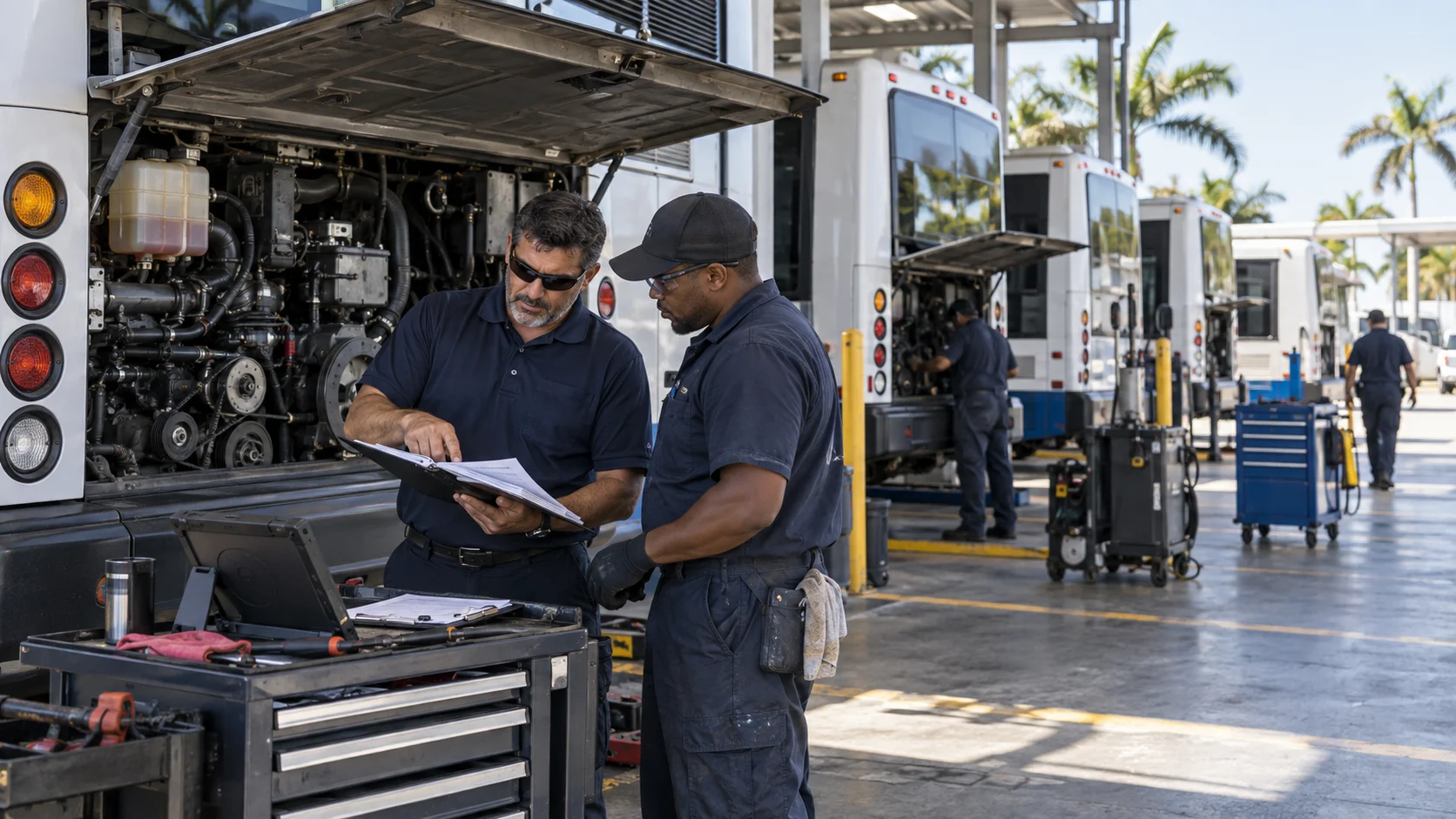
Heavy-duty distributors should stock coolant around the engine and fleet specifications present in their market, not around color alone. A defensible assortment identifies the coolant standard, OEM requirement, inhibitor chemistry, glycol base, premix or concentrate, service program, and compatibility with coolant already in the equipment.
The current Inforca website and supplied product markdowns do not verify an active coolant SKU. This article therefore explains how to build the category; it does not claim that Inforca currently stocks a particular antifreeze or coolant. Buyers should confirm the current product list and availability before placing an order.
What makes heavy-duty coolant different from a generic antifreeze label?
Heavy-duty coolant must manage heat while protecting metals, seals, pumps, and — in engines with wet cylinder liners — surfaces exposed to cavitation. The required inhibitor package and maintenance method depend on the engine and cooling-system design.
ASTM D6210 covers fully formulated glycol-base coolants for heavy-duty engines. The standard addresses protection against corrosion, cavitation, freezing, boiling, and scale when the coolant is correctly mixed and maintained. ASTM lists D6210-25 as the active edition.1
Cummins manuals may require a fully formulated ethylene-glycol coolant meeting ASTM D6210 and identify corrosion, foam, liner-pitting, and scale/deposit control as relevant functions.2 Other engines use their own OEM coolant specifications and approved-product lists.
Which information should control the stocking decision?
Use the customer’s equipment and maintenance requirements to define the assortment.
Collect:
- Engine manufacturer and model.
- Vehicle or equipment year.
- OEM coolant specification.
- Current coolant product and chemistry.
- Wet-liner or non-wet-liner engine design.
- Premix or concentrate preference.
- Glycol base required.
- Service interval and testing method.
- Supplemental coolant additive requirements.
- Fleet size and annual coolant use.
Do not convert a fleet from one chemistry to another based on color or a generalized compatibility claim. Review the OEM procedure, residual coolant, flush method, and product documentation.
What do IAT, OAT, NOAT, and hybrid mean?
These terms describe broad inhibitor-technology families. They help organize products, but they do not replace an OEM approval or specification.
| Technology term | General meaning | Stocking question |
|---|---|---|
| IAT or conventional | Inorganic additive technology, often used in traditional service programs | Does the system require SCA testing or maintenance additions? |
| OAT | Organic acid technology | Is the exact product accepted for the engine and compatible with the current fill? |
| NOAT | Nitrited organic acid technology | Does the OEM require or allow nitrite, and how is concentration maintained? |
| Hybrid or HOAT | Combination of organic and inorganic inhibitor approaches | Which OEM definition and product approval apply? |
The labels are not standardized enough to make two products interchangeable by acronym. Cummins’ Fleetguard portfolio, for example, separates OAT, NOAT, hybrid, and conventional products by technology, performance standards, and maintenance needs.3
Why is coolant color an unreliable selection method?
Color is a product identifier, not a universal chemistry code. Different manufacturers can use similar colors for different technologies, and one manufacturer can use several colors across its range.
Use the container label, product name, specification, TDS, service record, and OEM information. If the coolant already in the system cannot be identified, test and diagnose the condition before adding another product.
Do not tell a customer to “use the same color.” That instruction cannot establish glycol type, inhibitor chemistry, concentration, approval, contamination, or remaining service life.
Should a distributor stock premix, concentrate, or both?
Stock the form customers can use correctly and consistently. Premix simplifies concentration and water-quality control; concentrate supports sites with approved water and a controlled mixing process.
| Format | Advantage | Control required |
|---|---|---|
| Premixed coolant | Ready concentration and known water quality | Confirm the exact premix ratio and freeze/boil protection for the application |
| Concentrate | Flexible mix and potentially efficient transport or storage | Measure concentrate and approved water accurately; label the final mix |
Daimler Truck states that coolant selection, water quality, and correct mixing concentration all matter; too much additive package can be as unhelpful as too much water.4 Cummins likewise identifies water quality as important to scaling and corrosion control.5
Do not dilute a premixed coolant unless the manufacturer explicitly instructs it. Do not use untreated water because it is convenient.
Which standards and approvals should appear in the product file?
The product file should distinguish industry standards from OEM approvals and recommendations.
Possible evidence includes:
- ASTM D6210 for applicable fully formulated heavy-duty glycol coolant;
- ASTM D3306 for applicable light-duty service;
- engine-manufacturer engineering standards;
- OEM approved-product lists;
- TMC recommended practices where used by the fleet;
- product-specific TDS and SDS.
ASTM D6210 and D3306 address different service scopes; meeting one does not prove every OEM application.1 The engine manual controls the final choice.
Create one record per product with the exact claim wording. Do not turn “meets,” “recommended,” and “approved” into a single column.
How does wet-liner cavitation affect coolant selection?
Wet-liner engines can require coolant protection against cavitation erosion or liner pitting. Rapid pressure changes near the liner can form and collapse vapor bubbles, damaging the metal when the coolant chemistry and maintenance are inadequate.
ASTM D6210 specifically addresses cavitation-corrosion protection for heavy-duty engine coolants.1 Caterpillar also identifies cavitation reduction and corrosion protection as functions of its heavy-duty coolant products.6
Confirm whether the engine uses wet liners and whether the OEM requires nitrite, another inhibitor strategy, coolant filtration, or supplemental additives. Do not add SCA to an extended-life coolant unless the product and engine instructions require it.
Should distributors stock supplemental coolant additives and test strips?
Stock them only for coolant programs that specify them. Test strips and additives are chemistry-specific tools, not universal accessories.
For every SCA or test product, identify:
- coolant families it supports;
- parameter it measures;
- usable range;
- expiration and storage requirements;
- dosing procedure;
- OEM maintenance instruction;
- actions to take after an out-of-range result.
A test result should not be interpreted with instructions from another chemistry. The wrong strip or additive can produce a false decision or disturb the coolant balance.
How should a distributor prevent coolant mixing?
Keep product identity and chemistry visible from receiving through customer delivery.
Use:
- dedicated storage positions;
- product, chemistry, and specification labels;
- separate pumps or verified-clean transfer equipment;
- sealed containers;
- lot or batch records when available;
- a no-substitution rule without technical approval;
- staff prompts that ask for engine and current coolant;
- separate storage from lubricants, solvents, and used fluids.
If a product is sold as compatible with other coolants, read the qualifier. Compatibility may describe emergency mixing without guaranteeing full service life, approval coverage, or optimal inhibitor performance.
What should a distributor’s opening coolant assortment look like?
The opening assortment should cover verified fleet and shop demand with the fewest technically distinct products practical.
Build four groups:
- Core heavy-duty products: OEM/specification coverage requested repeatedly.
- Premix and concentrate forms: only where volume supports both.
- Maintenance products: chemistry-specific test strips, filters, extenders, or SCA when required.
- Special order: uncommon OEM or chemistry needs that should not occupy regular stock.
Record lost sales for 60 to 90 days before expanding. A missing product requested by one customer once is different from a specification requested by several active accounts.
Which customer questions should counter staff ask?
Ask questions that identify the cooling system:
- What engine and year is it?
- What coolant specification does the manual require?
- What product is in the system now?
- Is the system being topped off, drained and filled, or converted?
- Is premix or concentrate required?
- What water source and mixing process are used?
- Does the program require test strips, SCA, extender, or filters?
- How much does the fleet use?
When the current fluid is unknown or contaminated, refer the customer to a qualified cooling-system service process. Selling a “compatible” top-off without knowing the condition can hide a larger problem.
How should a Florida distributor plan coolant inventory?
Florida’s warm climate does not remove the need for antifreeze/coolant. The coolant still manages boiling margin, heat transfer, corrosion, cavitation, scale, seals, and pump protection.
Plan around local duty cycles such as stop-and-go delivery, idling, towing, construction work, and long-haul operation. Do not change the OEM concentration merely because freezing conditions are uncommon.
The engine manufacturer’s specification and mix ratio remain the baseline. Review water quality, cooling-system condition, radiator and pressure-cap performance, and maintenance records when overheating is present.
Does Inforca currently carry heavy-duty coolant?
The current public product pages reviewed for this article do not list a verified antifreeze or coolant product, and no coolant TDS appears in the supplied product-markdown set. Inforca’s active documented range covers engine oils, transmission and hydraulic fluids, gear oils, greases, brake fluids, maintenance products, accessories, and MATO equipment.7
Contact Inforca with the engine, OEM coolant specification, current product, chemistry, premix or concentrate requirement, annual volume, and delivery location. The team must confirm whether a current coolant option is available before any product recommendation is made.
Frequently asked questions about heavy-duty coolant stocking
Is ASTM D6210 enough to choose a coolant?
No. It is an important heavy-duty coolant standard, but the exact engine may require an OEM specification or approved product in addition to the ASTM claim.
Can OAT and NOAT coolant be mixed?
Do not mix them unless the product and OEM instructions explicitly allow it. Even when emergency compatibility is claimed, service life or maintenance requirements may change.
Is red coolant always OAT?
No. Color is not a universal chemistry standard.
Is premixed coolant always 50/50?
No. Read the product label and TDS. Do not assume concentration from the word premix.
Does heavy-duty coolant need SCA?
Some programs do; others explicitly do not. Follow the exact engine and coolant instructions.
Can a distributor recommend coolant from truck make alone?
Not reliably. Identify the engine, year, current fill, OEM specification, and service procedure.
Confirm the coolant category before stocking it
Send Inforca the engine models, OEM specifications, current coolants, chemistry, premix or concentrate needs, test and additive program, annual volume, and delivery ZIP code. Inforca can confirm whether a suitable current product is available; no coolant SKU should be assumed from the broader lubricant portfolio.
Sources
Footnotes
-
ASTM International, Subcommittee D15.07 — Active Engine Coolant Specifications, including ASTM D6210-25 and D3306-21, accessed September 10, 2026. ↩ ↩2 ↩3
-
Cummins, HDK Series Operations Manual — Coolant Recommendations, accessed September 10, 2026. ↩
-
Cummins, Aftermarket Portfolio, Rev. 1 January 2025, coolant technology comparison, accessed September 10, 2026. ↩
-
Daimler Truck, Mercedes-Benz Trucks Operating Fluids — Coolant, accessed September 10, 2026. ↩
-
Cummins, Coolant Recommendations and Specifications, accessed September 10, 2026. ↩
-
Caterpillar, Cat Coolants, accessed September 10, 2026. ↩
-
Inforca International, Products, accessed September 10, 2026. ↩
Send us the application, specification, and volume — our team will confirm the right product and format.
Talk to Inforca