


UHPD vs. SHPD Diesel Oil: What's the Difference?
SHPD means Super High Performance Diesel and UHPD means Ultra High Performance Diesel. Both are market descriptions for heavy-duty diesel oils. UHPD generally signals a more demanding performance position, but neither term is a complete or universally standardized engine-oil specification.
Choose by the engine maker’s required API category, ACEA sequence, OEM approval, SAE viscosity, and drain policy. Do not replace an SHPD oil with a UHPD product—or vice versa—based on the acronym alone.
How do SHPD and UHPD usually differ?
| Factor | SHPD position | UHPD position |
|---|---|---|
| General market meaning | High-performance heavy-duty diesel oil | Higher-tier or more demanding heavy-duty diesel oil |
| Common use | Mixed-age diesel fleets and severe service where listed specifications fit | Modern or highly loaded diesel engines, sometimes with extended-drain and aftertreatment requirements |
| Specification value | Acronym alone is insufficient | Acronym alone is insufficient |
| Selection proof | API/ACEA/OEM claims and approvals | API/ACEA/OEM claims and approvals |
Because suppliers can use the terms differently, compare the data sheets rather than the marketing tier.
Which specifications actually decide?
For North American fleets, API CK-4 and FA-4 are important current categories. API states that FA-4 oils are not interchangeable or backward compatible with CK-4, CJ-4, CI-4 PLUS, CI-4, or CH-4.1
For European heavy-duty engines, the current ACEA sequences include E4, E7, E8, and E11. ACEA introduced E8 and E11 in its 2022 edition and made that edition mandatory for new claims from May 2023.2
Engine approvals—such as Volvo VDS, Mack EOS, Renault RLD, Detroit Diesel, Cummins CES, MB, MAN, or Scania requirements—can be just as important as the industry category.
Does UHPD always mean CK-4?
No. A UHPD product may carry CK-4, an ACEA E category, and several OEM claims, but the word itself does not guarantee any of them.
Read:
- API service category;
- ACEA sequence and year;
- formal OEM approvals;
- manufacturer recommendations;
- viscosity;
- aftertreatment compatibility;
- published drain guidance.
Does UHPD allow a longer drain interval?
Not by itself. Drain interval depends on engine model, oil capacity, fuel sulfur, duty cycle, idle time, load, temperature, filtration, oil consumption, and the manufacturer’s program.
Where an extended interval is proposed, use OEM limits and oil analysis. Do not derive a mileage number from “UHPD.”
What about DPF, EGR, and SCR?
Aftertreatment compatibility must be documented through the relevant category or approval. ACEA E8 is strongly recommended by ACEA for engines fitted with particulate filters, while E11 addresses highly rated Euro I–VI engines under severe conditions; manufacturer instructions still control.3
Older SHPD formulations may not fit a modern DPF-equipped engine. A modern UHPD oil may also be wrong for an engine that requires a different viscosity or approval.
Which Inforca products fit the UHPD category?
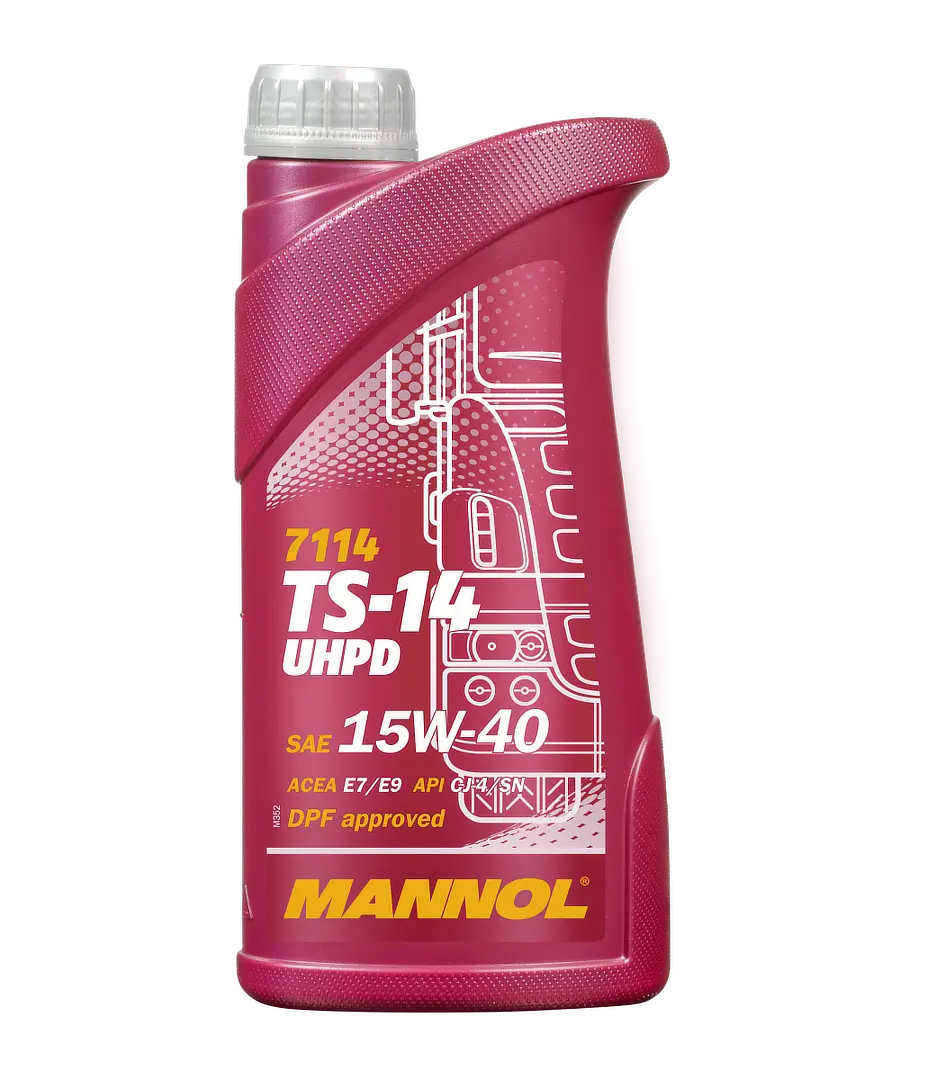
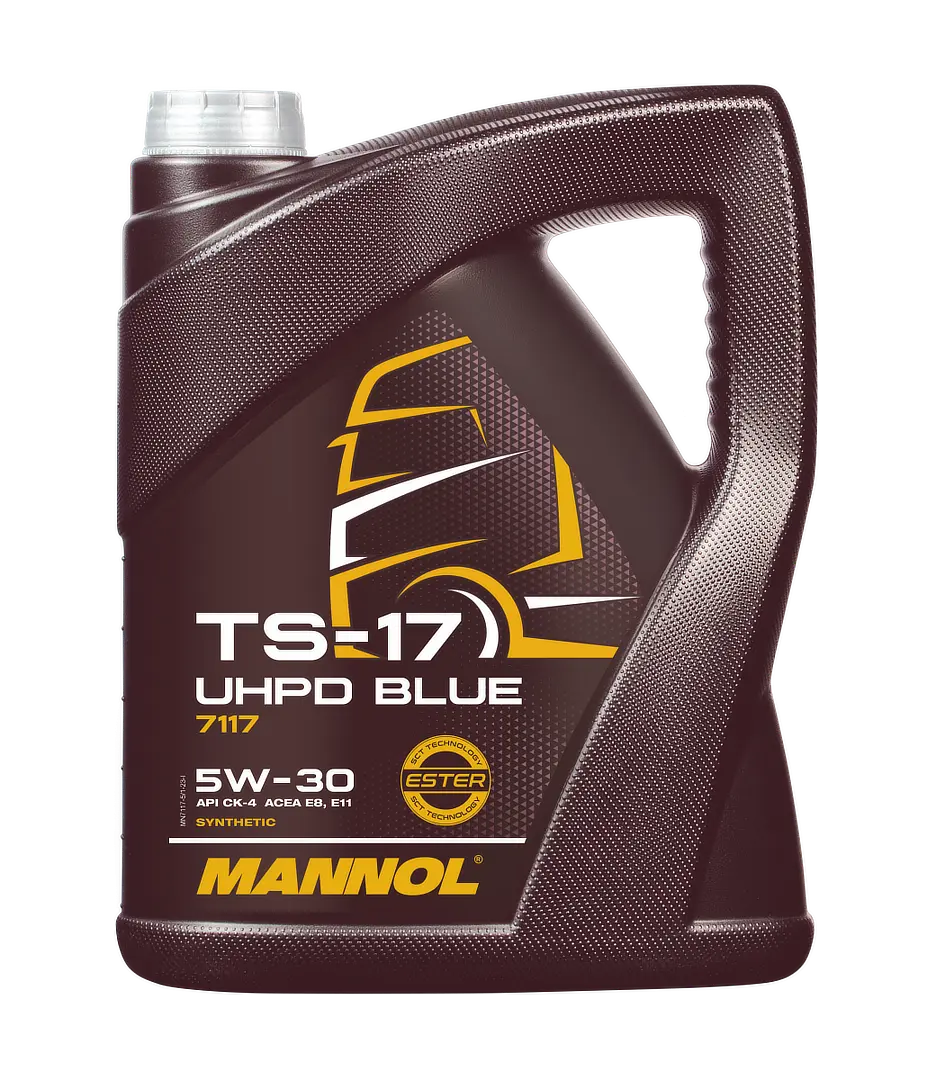
Inforca’s current MANNOL portfolio includes TS-14, TS-17, and TS-16 as UHPD products.4
| Product | Viscosity | Selected supplied-file coverage |
|---|---|---|
| MANNOL TS-14 UHPD, MN7114 | 15W-40 | API CK-4; ACEA E11-22/E7-22; Mack EOS-4.5, Renault RLD-3, and Volvo VDS-4.5 approvals; other listed specifications |
| MANNOL TS-17 UHPD, MN7117 | 5W-30 | API CK-4 and European/OEM coverage listed in its current file |
| MANNOL TS-16 UHPD | 5W-40 | API CK-4 on Inforca’s active list; current TDS and approval matrix must be confirmed |
Inforca also lists TS-18 15W-40 API CK-4, but the public product name does not classify it as UHPD. Do not infer a tier solely from the shared API category.
How should a fleet compare two diesel oils?
Build a line-by-line matrix:
- Engine make, model, and year.
- Emissions level and aftertreatment.
- Required API and ACEA category.
- Required OEM approval.
- Allowed SAE viscosity and ambient range.
- Normal and severe-service drain interval.
- Fuel sulfur and operating environment.
- Oil-analysis and top-off policy.
- Package, monthly volume, and handling.
If one oil lacks a mandatory line, the higher marketing tier does not fix the gap.
Frequently asked questions
Is UHPD better than SHPD?
It usually signals a higher market position, but “better” depends on the engine’s actual specifications.
Is SHPD obsolete?
Not as a marketing term, but older specifications commonly associated with it may be obsolete for modern engines. Check the exact claims.
Can UHPD be used in older diesel engines?
Often, if the current category is backward compatible and the viscosity and OEM instructions permit it. API notes that diesel backward compatibility is not universal.1
Is every UHPD oil synthetic?
No. Check the product’s base-oil description and specifications.
Can one UHPD oil cover the whole fleet?
Only if every engine’s current requirements appear in the verified coverage matrix.
Compare the required approvals
Send Inforca the engine list, API/ACEA/OEM requirements, viscosities, aftertreatment, duty cycle, current products, monthly volume, and package formats. The team can compare documented MANNOL and PureGuard options.
Sources
Footnotes
-
American Petroleum Institute, Oil Categories, accessed September 10, 2026. ↩ ↩2
-
ACEA, 2022 Oil Sequences for Heavy-Duty Engines, accessed September 10, 2026. ↩
-
ACEA, 2022 Heavy-Duty Oil Sequences, accessed September 10, 2026. ↩
-
Inforca International, MANNOL Active Product Families, accessed September 10, 2026. ↩
Related Inforca products
Check each product's data sheet against your exact specification before ordering.
Send us the application, specification, and volume — our team will confirm the right product and format.
Talk to Inforca