


What Is UHPD Oil and When Is It Needed?
UHPD means Ultra High Performance Diesel. It is a commercial description used for oils formulated for severe-duty diesel engines, high loads, soot control, and — depending on the product — extended intervals and modern aftertreatment systems.
UHPD is not an independent specification and does not guarantee compatibility. Selection must be confirmed through the API category, ACEA sequence, engine-maker approvals, and SAE grade.
What problems is a UHPD oil intended to control?
A UHPD oil is commonly positioned to help control:
- wear under high load;
- high-temperature oxidation;
- soot-related thickening;
- piston and turbo deposits;
- corrosion;
- aeration and foam;
- compatibility with DPF, EGR, and SCR when the formulation and approvals indicate it.
The word UHPD alone does not prove any of these levels. The data sheet must show the categories and approvals supporting the application.
Is UHPD the same as API CK-4?
No. API CK-4 is a formal service category for diesel-engine oils. UHPD is a positioning term.
One UHPD product may claim API CK-4, ACEA E11, and OEM approvals. Another may use different categories. API warns that for diesel oils, a newer category generally — but not always — includes the performance of an earlier one, and API FA-4 is neither interchangeable with nor backward-compatible with CK-4.1
What role does ACEA play?
The ACEA E sequences define performance levels for heavy-duty diesel engines. In the 2022 edition, ACEA introduced E8 and E11 and updated E4 and E7.2
In summary:
| Category | General focus | Caution |
|---|---|---|
| ACEA E7 | High-output diesel engines, generally without DPF, with wear, soot, and deposit control | Consult the manufacturer for the engine and interval |
| ACEA E8 | Very severe service and strong aftertreatment compatibility, especially DPF | Designed for low-sulfur fuel; confirm OEM |
| ACEA E11 | Cleanliness, wear, soot, and stability control in Euro I–VI engines | Application and interval depend on the manufacturer |
Do not select only by “E” plus a number. The engine requires a specific combination.
When might UHPD be needed?
It may be appropriate when the manual requires the categories and approvals shown on a UHPD oil, especially for:
- long-haul trucks;
- buses and urban transport;
- construction or mining equipment;
- agricultural machinery;
- engines with EGR, SCR, or DPF;
- high-load and sustained-temperature cycles;
- drain programs controlled by the manufacturer or analysis.
Severe work does not authorize changing viscosity or extending the interval independently.
Does UHPD mean a longer oil-change interval?
Not automatically. A formulation may support extended intervals, but the authorized interval depends on engine, fuel, load, idle time, oil consumption, sump capacity, filtration, and analysis program.
Volvo Trucks guidance, for example, links VDS-4.5 with CK-4 and defines viscosity and interval by engine and operation.3 That rule cannot be transferred to another engine brand.
What UHPD options does Inforca currently offer?
Inforca publishes an active MANNOL UHPD family for heavy-duty service.4
| Product | Coverage documented in the supplied file | Documented presentations |
|---|---|---|
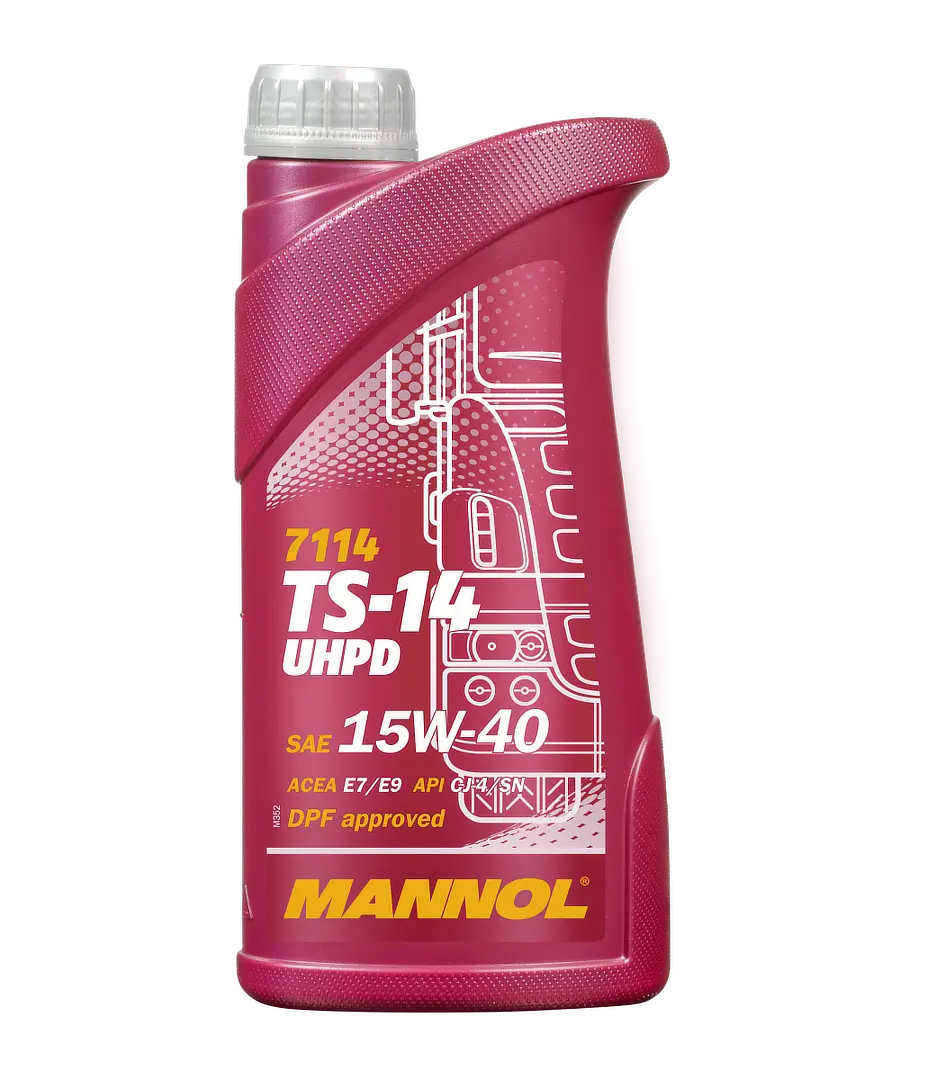
| MANNOL TS-14 UHPD 15W-40, MN7114 | API CK-4; ACEA E11-22, E7-22, and E9-16; MACK EOS-4.5, Renault RLD-3, and Volvo VDS-4.5 approvals; other listed specifications | 20 L and 208 L |
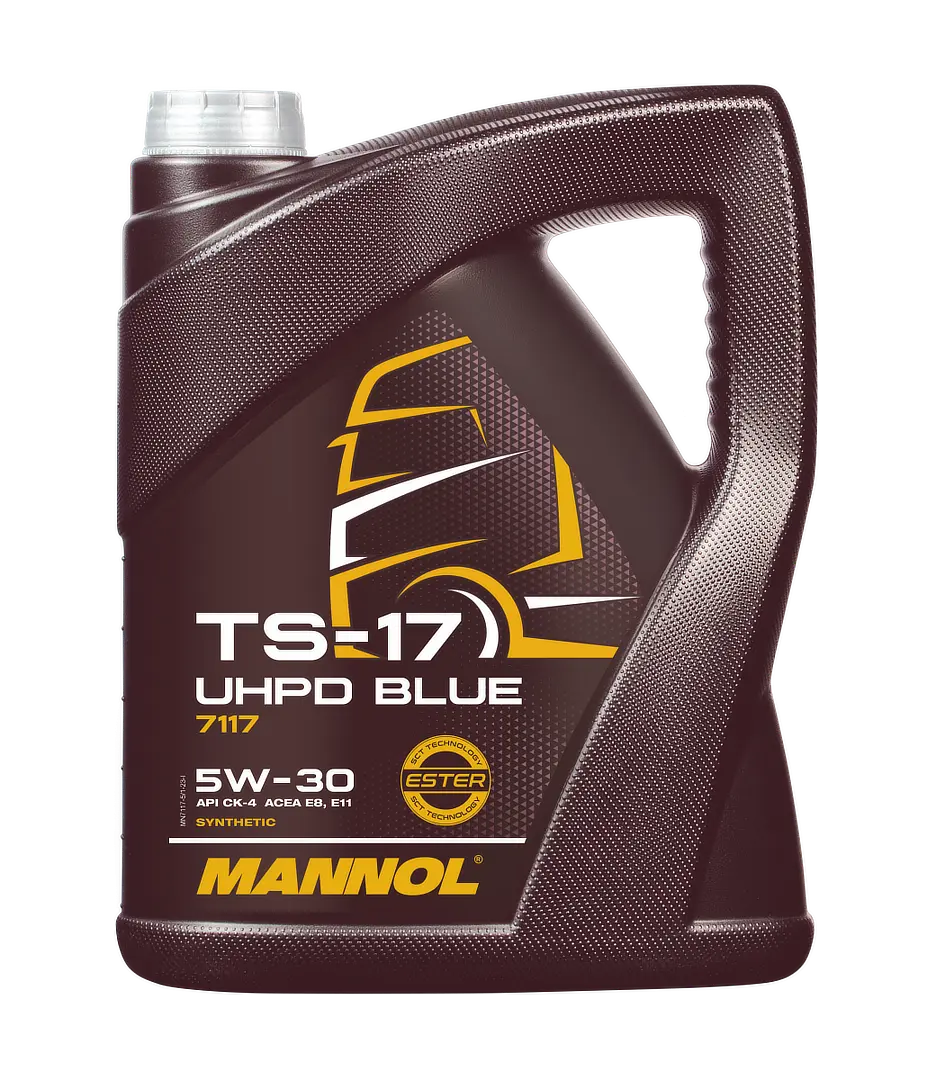
| MANNOL TS-17 UHPD 5W-30, MN7117 | API CK-4 and European/OEM coverage stated in its data sheet | Confirm current presentation and availability |
| MANNOL TS-16 UHPD 5W-40 | API CK-4 according to Inforca’s active list | Confirm data sheet, reference, and presentations |
MANNOL TS-18 15W-40 API CK-4 also appears in the active heavy-duty family, although its public name does not identify it as UHPD. Do not reclassify it solely because it shares CK-4.
How is the correct product selected?
Collect:
- Engine manufacturer, model, and series.
- Year and emissions standard.
- Required API, ACEA, and OEM approval.
- SAE grade permitted for ambient temperature.
- Presence of DPF, EGR, and SCR.
- Fuel type and sulfur content.
- Duty cycle, load, idle time, and hours.
- Current interval and analysis program.
- Monthly use and purchase format.
Use UHPD at the end as a product description, not at the beginning as the only criterion.
Frequently asked questions about UHPD
Does UHPD work for every diesel truck?
No. It must match the engine specifications.
Is UHPD always synthetic?
No. Base stock may vary. Check the product data sheet.
Is 15W-40 UHPD better than 10W-30?
Not in absolute terms. They are different viscosities. Use the one allowed for the engine and operating temperature.
Can CK-4 replace CJ-4?
Often, but API states that diesel backward compatibility is not universal. Confirm the engine maker, fuel, and interval.1
Is FA-4 a better version of CK-4?
No. FA-4 is a different category for certain engines and is not interchangeable with CK-4.
Confirm the engine, approval, and viscosity
Send Inforca the engine make, model, and series; year; API/ACEA/OEM requirement; viscosity; aftertreatment; duty cycle; monthly volume; and presentation. The team can compare TS-14, TS-17, TS-16, and the other documented options.
Sources
Footnotes
-
American Petroleum Institute, Diesel Engine Oil Categories, accessed September 10, 2026. ↩ ↩2
-
ACEA, 2022 Oil Sequences for Heavy-Duty Engines, accessed September 10, 2026. ↩
-
Volvo Trucks USA, Engine Oil Type and Quality for D11, D13, and D16, accessed September 10, 2026. ↩
-
Inforca International, MANNOL: Active Heavy-Duty Oils, accessed September 10, 2026. ↩
Related Inforca products
Check each product's data sheet against your exact specification before ordering.
Send us the application, specification, and volume — our team will confirm the right product and format.
Talk to Inforca